ADA Title II Web Accessibility Rule: Deadlines, Requirements, and How to Comply
Table of Contents
- ADA Title II Web Accessibility Rule: Deadlines, Requirements, and How to Comply
- What Is ADA Title II?
- Who Has to Comply?
- ADA Title II Deadlines
- What the Rule Requires
- The Five Exceptions
- A Six-Step Plan to Comply
- Common Trouble Spots
- What Happens If You Miss the Deadline?
- Get a Clear Scope Before Budget Season
- Frequently Asked Questions
State and local governments now have a specific technical standard and firm dates for digital accessibility. Under the Department of Justice’s ADA Title II rule, public websites and mobile apps must meet WCAG 2.1 Level AA. In April 2026, the DOJ moved the compliance dates back one year, to April 2027 and April 2028. The rule affects every public website, from a state benefits portal to a small water district’s bill-pay page.
The extension changes the timing, not the obligation. This guide covers who the rule applies to, the current deadlines, what is required, the exceptions, and a six-step plan to comply. It is general information, not legal advice.
What Is ADA Title II?
Title II of the ADA, sometimes written as ADA Title 2, prohibits discrimination against people with disabilities in the services, programs, and activities of state and local governments. On April 24, 2024, the DOJ published a final rule that applies this to digital services by naming a technical standard for web content and mobile apps. The DOJ fact sheet summarizes the rule in plain language.
Before this rule, the ADA already required accessible government services, but it did not say how to measure a website. The rule closes that gap with a published standard and compliance dates.
Who Has to Comply?
The rule covers public entities of every size:
- State governments and their agencies and departments
- Counties, cities, towns, and villages
- Public school districts, community colleges, and public universities
- Special districts such as transit, water, park, and library districts
- Amtrak and other commuter authorities
Governments are also responsible for content that contractors and software vendors provide on their behalf. Private businesses fall under Title III, which has no equivalent web rule. Vendors that sell software to public entities feel the rule indirectly, because buyers now ask for proof of conformance.
ADA Title II Deadlines
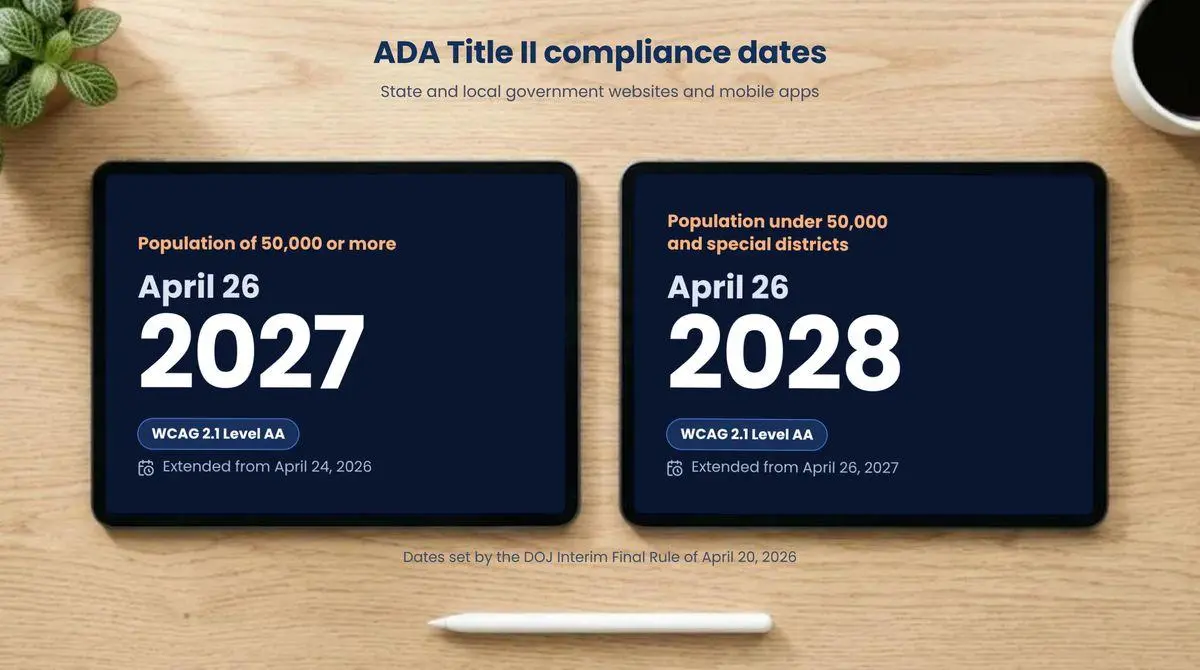
The compliance date depends on the population of the public entity. A department or agency generally uses the population of the government it belongs to, so a county sheriff’s office follows the county’s date.
| Public entity | Original date | Current compliance date |
|---|---|---|
| Population of 50,000 or more | April 24, 2026 | April 26, 2027 |
| Population under 50,000 | April 26, 2027 | April 26, 2028 |
| Special district governments, any size | April 26, 2027 | April 26, 2028 |
The new dates come from an Interim Final Rule published on April 20, 2026. The National Federation of the Blind has challenged the extension in federal court, so confirm the current ADA Title II deadline on ADA.gov before you plan around it. The DOJ also states that covered entities have an ongoing obligation to make their web services accessible, regardless of the compliance dates.
What the Rule Requires
The standard is WCAG 2.1 Level AA, published by the World Wide Web Consortium. It contains 50 success criteria covering text alternatives, captions, color contrast, keyboard access, form labels, and more. For ADA Title II digital accessibility, the rule applies to:
- Websites and web applications, including portals for payments, permits, and records
- Mobile apps the entity provides or makes available
- Documents posted online, such as PDFs, forms, and meeting agendas
- Video and audio content
- Content delivered through third-party vendors
Level AA builds on Level A. In practical terms, a conformant site lets a resident complete a task such as paying a bill with a keyboard alone, with a screen reader, at 200% zoom, and with captions on any video.
The Five Exceptions
The rule exempts five narrow categories of content:
- Archived web content kept only for reference, research, or recordkeeping and not changed since it was archived.
- Preexisting documents (word processing, presentation, PDF, and spreadsheet files) posted before the compliance date, unless they are still used to apply for or access services.
- Third-party content posted by members of the public, such as comments on a message board.
- Individualized, password-protected documents about a specific person, property, or account.
- Preexisting social media posts made before the compliance date.
Even where an exception applies, the entity must still provide effective communication and equal access when someone asks.
A Six-Step Plan to Comply
Most public entities follow the same sequence.
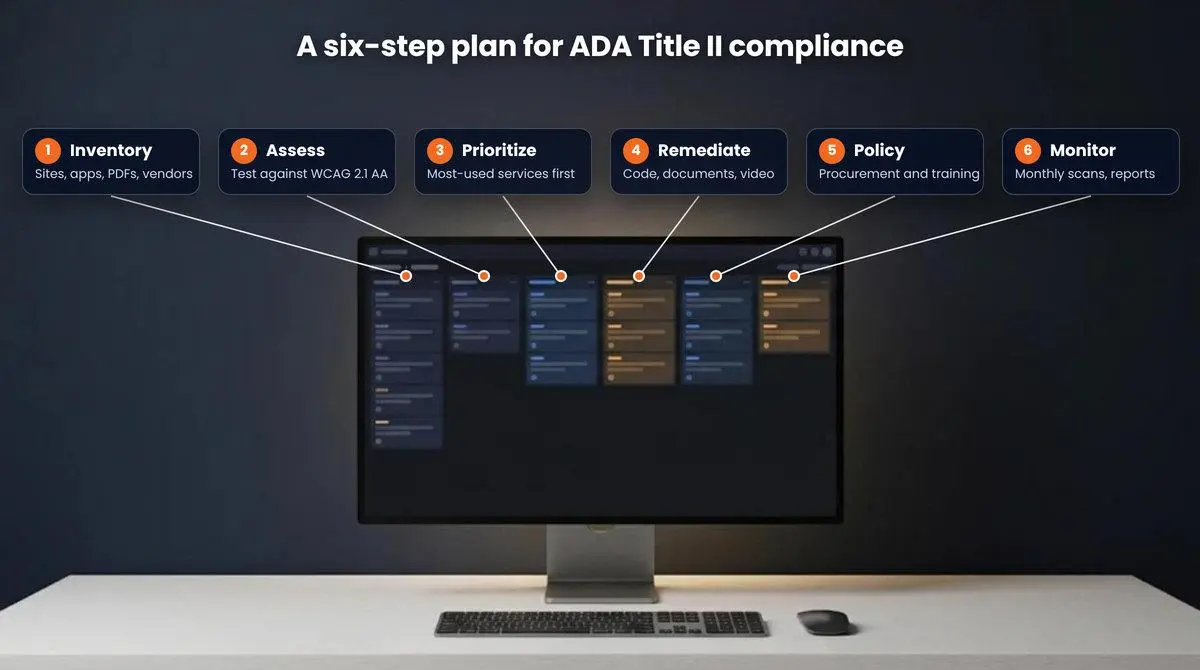
- Inventory. List every website, app, document library, and vendor portal.
- Gap assessment. Test representative pages and documents against WCAG 2.1 AA with automated scans and manual checks using assistive technology. A website accessibility audit sets the scope and cost.
- Prioritize. Fix the services residents use most first: payments, applications, permits, and emergency information.
- Remediate. Correct templates and code, tag documents, and caption video. Accessibility remediation should end with a retest.
- Policy, procurement, and training. Adopt an accessibility policy, require a VPAT or ACR from vendors, and train the staff who publish content.
- Monitor. Scan monthly, spot check manually, and report progress to leadership.
Timelines vary with size. An inventory usually takes one to two weeks, and a gap assessment a few weeks more. Remediation is the long phase, because it depends on how many templates, documents, and vendor systems need work. Starting the inventory now leaves time to budget and procure before the deadline year.
Common Trouble Spots
- Vendor portals. Payment, permitting, and agenda systems come from third parties, but the government entity is accountable for them.
- Mobile apps. The rule covers apps as well as websites, so accessibility belongs in mobile app development requirements.
- Video. Recorded meetings and public announcements need captions.
- Maps and dashboards. Interactive maps and charts need text alternatives or accessible data tables.
What Happens If You Miss the Deadline?
Title II is enforced through complaints to the DOJ, federal investigations, and private lawsuits. Entities that can show an inventory, a remediation plan, and steady progress are in a stronger position than those that have not started. Large sites take months to fix, so waiting until the final year before the ADA Title II compliance deadline leaves little margin. Some states also have their own digital accessibility laws with separate penalties.
Get a Clear Scope Before Budget Season
Plego’s ADA Title II compliance program follows the same six steps and includes a board-ready summary of scope, cost, and order of work. Our broader ADA compliance services cover audits, remediation, document work, and training. Contact us to schedule a gap assessment.
Frequently Asked Questions
What is ADA Title II?
ADA Title II is the part of the Americans with Disabilities Act that prohibits disability discrimination in the services, programs, and activities of state and local governments. A 2024 Department of Justice rule applies it to websites and mobile apps with a specific technical standard.
What is the ADA Title II deadline for website accessibility?
Public entities with a population of 50,000 or more must comply by April 26, 2027. Entities with a population under 50,000 and all special district governments have until April 26, 2028. The DOJ set these dates in an Interim Final Rule in April 2026.
What standard does the ADA Title II rule require?
The rule requires web content and mobile apps to conform to WCAG 2.1 Level AA, the Web Content Accessibility Guidelines published by the World Wide Web Consortium.
Does ADA Title II apply to private businesses?
No. Title II covers state and local governments. Private businesses that are open to the public fall under Title III of the ADA, which has no specific web regulation, although WCAG Level AA is the common benchmark.
Does the rule cover PDFs and mobile apps?
Yes. Documents posted online and mobile apps a public entity provides or makes available are covered. Some preexisting documents are exempt, unless they are still used to apply for or access services.
Does a small town or special district have to comply?
Yes. Public entities of every size are covered. Entities with a population under 50,000 and special district governments have the later compliance date of April 26, 2028.
What should a public entity do first?
Start with an inventory of websites, apps, documents, and vendor portals, then run a gap assessment against WCAG 2.1 AA. Those two steps produce the scope, cost, and order of work needed for budgeting.