


Privileged Access Management

Client – Enterprise IT Infrastructure
Client Profile
The client relied on administrative and service accounts to manage critical systems, applications and infrastructure. Because these accounts carried elevated permissions, they functioned like “master keys” to the organization’s technology environment.
Industry
Construction
Business Challenge
The client’s IT environment included shared administrator accounts, individual IT administrator accounts and service accounts used by business applications.
Many of these accounts had passwords that were outdated, rarely changed or had never been rotated. Some credentials were also shared among multiple users, making it difficult to determine who accessed a system or performed a specific action.
Several legacy systems did not support Multi-Factor Authentication, leaving an additional access path that could not be protected through modern authentication methods alone.
The key challenges included:
- Shared administrator and service account credentials
- Passwords that were outdated or never rotated
- Limited visibility into privileged account activity
- Difficulty identifying who accessed critical systems
- Legacy systems that did not support Multi-Factor Authentication
- Static credentials that could provide long-term unauthorized access
- Insufficient records for security investigations and audits
If one of these credentials was stolen, exposed or misused, an attacker could potentially gain extensive access to the client’s systems without being detected.
Solution
Plego was engaged to identify these high-risk accounts, secure their credentials and establish greater control over when and how they could be accessed.
Plego implemented a comprehensive Privileged Access Management solution to discover, secure and monitor privileged accounts across the client’s environment.
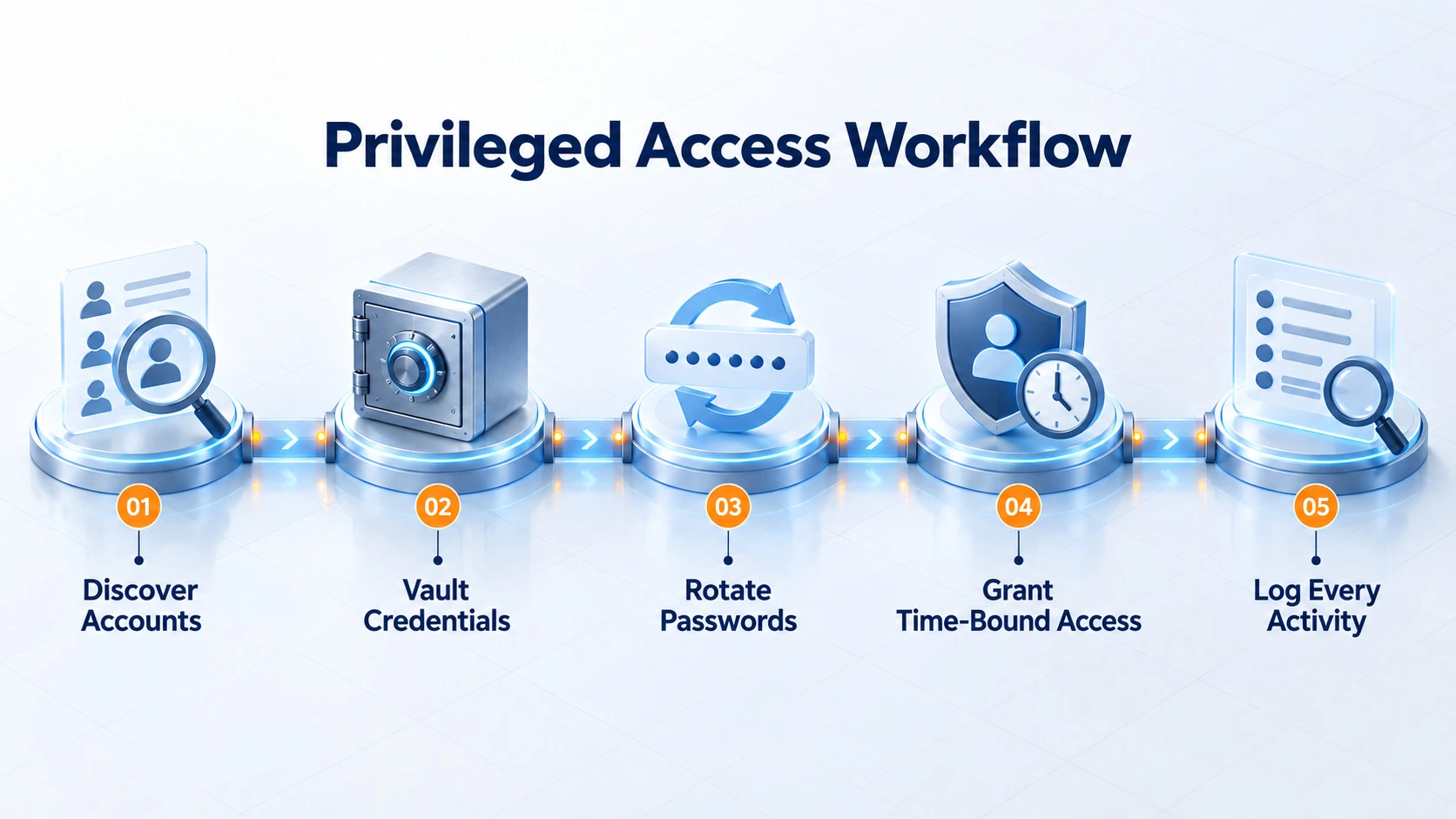
Every privileged account was identified and documented. Credentials were then moved into a secure password vault, removing the need for employees or applications to store and share static passwords.
Automated password rotation, restricted sessions, controlled access through jump hosts and detailed activity logging created multiple layers of protection. These controls secured both modern systems and legacy platforms that could not support Multi-Factor Authentication.
Privileged Account Discovery
The first step was to identify and inventory every account with elevated access across the organization.
This included:
- Shared administrator accounts
- Individual IT administrator accounts
- Application service accounts
- System-level accounts
- Accounts connected to legacy platforms
Creating a complete inventory gave the client a clear view of which privileged accounts existed, where they were being used and which systems they could access.
This also eliminated unknown or unmanaged privileged accounts that could otherwise remain hidden within the environment.
Secure Credential Vaulting
Plego moved privileged credentials into a protected digital vault using Privileged Access Management technology.
Instead of employees viewing, remembering or sharing sensitive passwords, authorized users could request access through a controlled process. The vault securely managed the credentials and reduced the risk of passwords being stored in documents, emails, scripts or other unsecured locations.
Credential vaulting provided:
- Centralized protection for privileged passwords
- Reduced credential sharing among users
- Greater control over who could access critical accounts
- Less exposure of sensitive passwords
- A consistent process for requesting privileged access
Automated Password Rotation
Automated password rotation was implemented to eliminate long-term static credentials.
Passwords could be changed automatically after every authorized checkout or according to a predefined schedule. This meant that a password used during one access session would not remain valid indefinitely.
Automated rotation reduced the risk associated with stolen, copied or previously shared credentials. It also removed the administrative burden of manually changing passwords across multiple systems.
The client gained:
- Automatic password changes after use
- Scheduled rotation for applicable accounts
- Elimination of unchanged privileged credentials
- Reduced risk from exposed or stolen passwords
- Consistent password management across the environment
Legacy System Protection
Some of the client’s legacy systems could not support Multi-Factor Authentication. Replacing these systems immediately was not practical, but leaving them unprotected would have created a significant security gap.
Plego introduced compensating security controls to reduce this risk.
Access to these systems was restricted through controlled jump hosts and limited sessions. Users first connected through a secured access point before reaching the protected system, creating an additional layer of oversight.
These controls allowed the client to secure older platforms without interrupting the applications and processes that depended on them.
Controlled and Time-Bound Access
Privileged access was limited to approved users and authorized periods.
Instead of providing permanent access to sensitive systems, permissions could be granted only when required and for a specific amount of time. Once the approved period ended, the access expired.
This approach reduced unnecessary exposure and prevented privileged access from remaining active longer than needed.
It also allowed the client to answer important security questions, including:
- Who requested access?
- Which privileged account was used?
- What system was accessed?
- When did the session begin and end?
- Was the access properly authorized?
Privileged Activity Logging
Every privileged access event was logged to create a clear and reliable record of activity.
The client gained visibility into when an account was accessed, who received authorization and how long the access remained active. This information could be used for internal investigations, security reviews and regulatory audits.
The improved audit trail provided:
- Greater accountability for privileged activity
- Faster investigation of suspicious access
- Reliable documentation for security reviews
- Better preparation for regulatory audits
- Clear visibility into employee and system-level accounts
Outcome
The client achieved an audit-ready inventory of every privileged account across its environment.
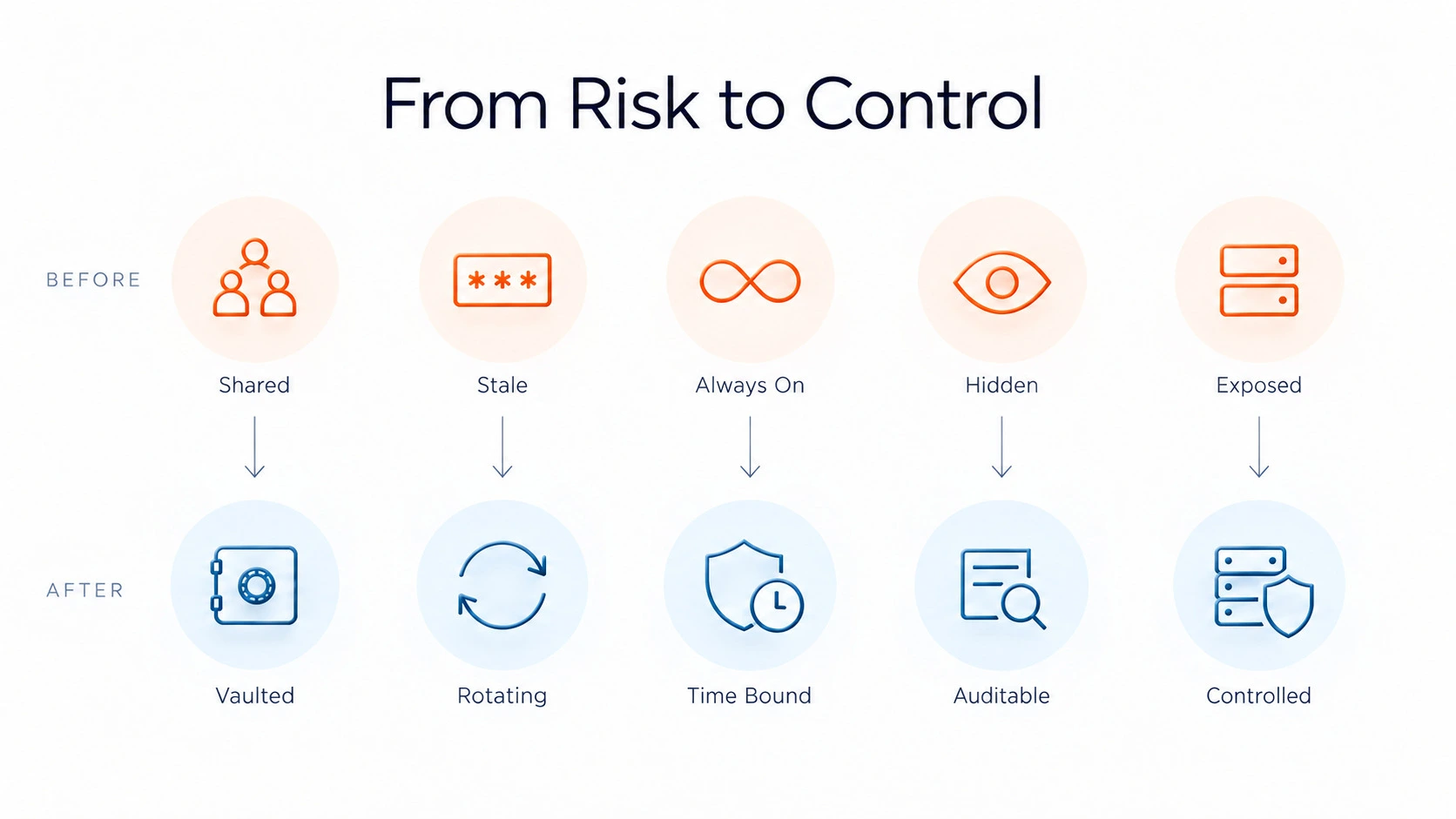
Privileged passwords were secured in a central vault and rotated automatically after use or according to defined schedules. Static credentials were eliminated, and every access event became controlled, logged and limited to an approved period.
Key outcomes included:
- Complete inventory of privileged accounts
- Secure storage of administrative and service account credentials
- Automatic password rotation
- Removal of long-term static credentials
- Controlled access to legacy systems
- Time-bound privileged access
- Complete logging of privileged account activity
- Full audit trail for security and regulatory reviews
- No disruption to daily business operations
Business Impact
The solution closed one of the most common paths attackers use to gain extensive access to business systems.
By securing both employee-managed administrator accounts and application-level service accounts, Plego helped the client reduce the risk of credential theft, unauthorized access and undetected activity.
The organization now has centralized control over its most sensitive accounts, clear accountability for every access event and stronger protection for legacy systems, all without interrupting its daily operations.
Technologies Used
Privileged Access Management, Credential Vaulting, Automated Password Rotation, Secure Jump Hosts
Services Provided
Cybersecurity, Identity and Access Management
