

Top Mistakes Startups Make with New Product Development
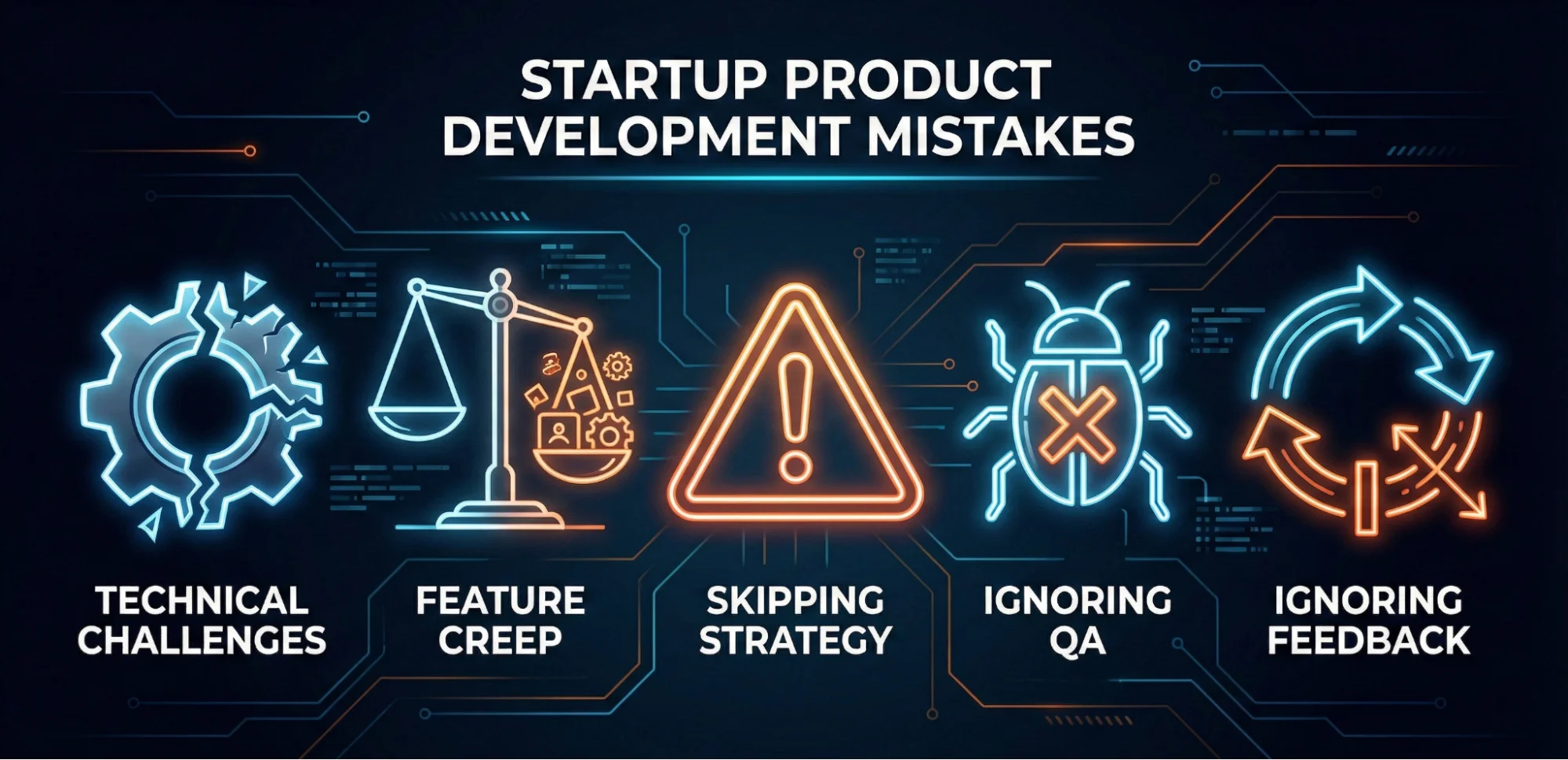
Table of Contents
- Top Mistakes Startups Make with New Product Development
- Skipping the “Boring” Homework (Lack of Strategy)
- The Feature Creep Trap: Why Bigger Isn’t Better
- Treating Quality Assurance as an Afterthought
- Underestimating the Technical Challenge
- Ignoring the Feedback Loop
- Hiring for the Wrong Phase
- Frequently Asked Questions
- Conclusion: Build Smart, Not Just Fast
We’ve all heard the statistic: 90% of startups fail. It’s a number that gets thrown around in pitch decks and boardrooms constantly. But here’s what they don’t usually tell you, the vast majority of those failures aren’t because the founders lacked passion or funding. They failed because they built the wrong thing, or they built the right thing the wrong way.
When you are deep in the trenches of coding and designing, it’s easy to lose sight of the bigger picture. You fall in love with your solution rather than the problem you’re solving.
At Plego, we’ve worked with enough founders to see the same patterns repeat themselves. The road to a successful launch is paved with good intentions, but it’s also riddled with startup product development mistakes that are entirely preventable.
If you are currently mapping out your roadmap or sweating over your next sprint, this guide is for you. Let’s look at where things go wrong and, more importantly, how to keep your product on the rails.
Skipping the “Boring” Homework (Lack of Strategy)
The biggest adrenaline rush for any product team is the “build” phase. Opening the IDE, sketching the wireframes, seeing the first button click, it’s intoxicating. But diving into development without a validated product strategy is the fastest way to burn cash.
A famous study by CB Insights found that the number one reason startups fail (42% of cases) is simply “no market need.” They built a solution looking for a problem. Many founders confuse a “cool idea” with a “viable product.” They assume that because they need it, everyone else does too. This assumption is dangerous.
How does Product Strategy help startups avoid failure?
A solid strategy acts as a filter. It forces you to step back and ask the hard questions before writing a single line of code. Who is the user? What are they currently using? Why would they switch?
Effective product strategy isn’t just about a vision board; it’s about data. It involves:
- Competitor Analysis: Knowing who you are up against.
- User Interviews: Getting out of the building and talking to humans.
- Value Proposition Design: Defining exactly why your product matters.
Without this compass, you aren’t building a business; you’re engaging in an expensive hobby.
The Feature Creep Trap: Why Bigger Isn’t Better
I once consulted for a team building a fitness app. They wanted social feeds, calorie tracking, artificial intelligence workout generation, and integration with every wearable device on the market, all for version 1.0.
They didn’t launch for two years. By the time they did, the market had moved on.
This is the classic error of ignoring MVP Development pitfalls. There is a massive psychological barrier for founders to release something that feels “incomplete.” But trying to build the “perfect” product right out of the gate is a recipe for disaster.
How can MVP Development reduce risks for startups?
The Minimum Viable Product (MVP) is not about building a “cheap” version of your product. It’s about building the smallest version that delivers value. When you focus on lean MVP Development, you reduce risk in three specific ways:
- Financial Risk: You spend less money validating your core hypothesis.
- Time Risk: You get to market faster (months instead of years).
- Market Risk: You get feedback sooner. If users hate feature A but love feature B, you can pivot before you’ve sunk your entire budget into feature A.
Focus on one core problem. Solve it exceptionally well. The bells and whistles can wait for version 2.0.
Treating Quality Assurance as an Afterthought
“We’ll fix the bugs in the next update.”
This sentence should be a red flag in any product meeting. In the rush to meet arbitrary launch dates, Quality Assurance in new product launches often gets the short end of the stick.
In the B2B tech world, your reputation is your currency. If your SaaS platform crashes during a client demo or deletes user data on day one, you rarely get a second chance. First impressions are sticky, and in the age of social media, bad reviews spread faster than good ones.
Why is Quality Assurance critical in product launches?
QA isn’t just about finding bugs; it’s about user trust. A buggy product signals to your users that you don’t value their time or their data. Research by the NIST has shown that the cost of fixing a bug increases significantly the later it is found in the development cycle fixing a bug post-launch can cost up to 100x more than fixing it during design.
Effective Quality Assurance involves:
- Automated Testing: Catching regressions before they hit production.
- User Acceptance Testing (UAT): Letting real users break the system in a controlled environment.
- Performance Testing: Ensuring your app doesn’t freeze when 1,000 users log in at once.
Investing in QA upfront saves you from the “technical debt” nightmare later, where your developers spend 100% of their time fixing old code rather than building new features.
Underestimating the Technical Challenge
One of the most frequent product development challenges is the optimism bias regarding timelines. Developers (bless them) are optimists. They look at a feature and think, “I can knock that out in two days.”
They often forget to account for the hidden complexities, such as integration with third-party APIs, legacy code refactoring, or strict security compliance like GDPR or SOC2.
When timelines slip, panic sets in. Features get cut haphazardly, or teams are forced to “crunch,” leading to sloppy code and morale issues.
The Reality of Product Development Challenges
To combat this, startups need to adopt agile methodologies that allow for flexibility. Stop treating your roadmap as a rigid contract. It should be a living document that evolves as you learn more about the technical constraints and user needs.
Pad your estimates. If engineering says it will take two weeks, plan for three. It’s better to under-promise and over-deliver than to explain to your investors why the launch is delayed by another month.
Ignoring the Feedback Loop

The launch is not the finish line; it’s the starting gun.
Some startups make the mistake of launching and then immediately moving on to the “next big feature” without stopping to breathe and listen. They look at vanity metrics like “total signups” rather than actionable metrics like “daily active users” or “churn rate.”
What are the most common mistakes in product development post-launch? It’s silence. It’s failing to set up channels where users can complain, suggest, and praise.
You need tools like Hotjar to see where users are clicking, or Intercom to chat with them directly. You need to read every support ticket. The roadmap for the next six months shouldn’t come from your CEO’s intuition; it should come from the frustration and desires of your current user base.
Hiring for the Wrong Phase
A startup in the seed stage needs different engineers than a startup in Series C.
In the beginning, you need “pirates” generalists who can hack together solutions, work across the full stack, and are comfortable with chaos. As you scale, you need “navy seals” specialists who care about stability, scalability, and process.
Hiring specialists too early can slow you down with unnecessary bureaucracy. Hiring generalists too late can lead to a codebase that collapses under its own weight. Align your team composition with your product’s lifecycle stage.
Frequently Asked Questions
What is the biggest mistake in startup product development?
Building without a verified market need. 42% of startups fail because they solve a problem no one cares about. Startups must prioritize product strategy and user research before writing code.
How does an MVP reduce development risk?
An MVP (Minimum Viable Product) focuses on core features only. This approach lowers custom software development costs, accelerates time-to-market, and allows you to pivot based on real user feedback rather than assumptions.
Why is Quality Assurance (QA) vital for new products?
QA protects your brand. Launching with bugs destroys user trust instantly. Comprehensive testing and QA services ensure your app is secure, stable, and ready for high traffic on day one.
What is the difference between a prototype and an MVP?
A prototype is a visual mock-up used for design testing (often part of UI/UX design). An MVP is a functional, releasable product that early customers can actually use to solve their problems.
Conclusion: Build Smart, Not Just Fast

Building a product is one of the hardest things you can do in business. The odds are stacked against you, and the market is unforgiving.
However, by avoiding these common startup product development mistakes, skipping strategy, bloating your MVP, neglecting QA, and ignoring feedback, you drastically improve your chances of survival.
Don’t fall in love with your solution. Fall in love with solving the problem for your customer. That is the only strategy that never fails.
Is your product roadmap actually leading you to a cliff? Let’s review your strategy before you write another line of code.
Contact Us